Sunday, November 2, 2014

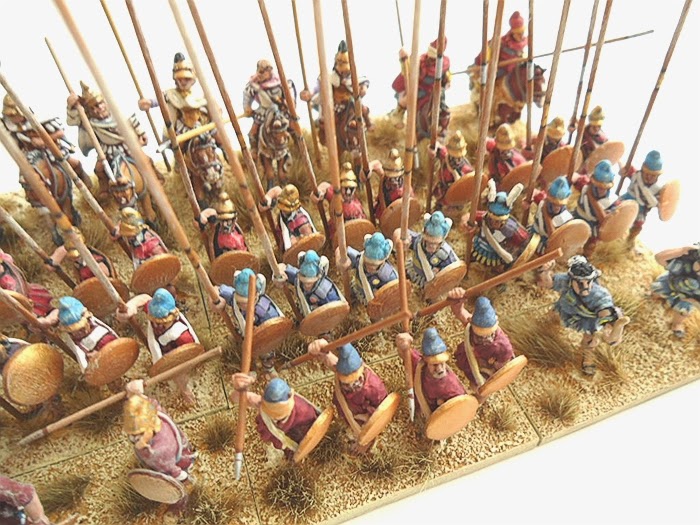
II/12 Alexandrian Macedonian

355 BC - 320 BC

DBA 2.2  
Army Composition: (12 elements) Miniatures by Xyston

1 x 3Kn (Gen) 1 x 3Cv, 1 x 2Lh, 6 x 4Pk, 1 x 4Ax, 2 x 2Ps

Historical Enemies: Illyrians, Skythians,Thracians, Lykian, Paionian, ThebanAitolianBithynians and Later Achaemenid Persian.

Historical Notes:  Here are my two cents worth about Alexander the Great. He wanted to knock out and conquer the 4 wealthiest nations/empires during his life time.

1) The Persian Empire
2) India (manage to defeat only one of nine factional states in India)
3) Carthage
4) Rome (Sicily/Italy)

;o) Alexander (along with his arrogance and narcissism) probably regretted spending 2 to 3 years of guerrilla warfare and sieges in Bactria (modern day Afghanistan and Tajikistan) If he decided to by pass Bactria all together and launch a quick and decisive campaign in India instead, the Bactrians may or would have formed an alliance? Thus securing his Northern and Eastern flanks of his Empire. Alex would then march back to his Capitol city and base of operations Babylon (Iraq) raised new armies and headed West bound for North Africa, conquer Carthage, grab/use the Carthaginian Fleet (if still intact) invaded Sicily and southern Italy and march and conquer the Romans...... who knows? :o)

anyway....enough of my "what if"  :o) This Alexandrian Macedonian Army is basically an all out infantry defense force. Pikemen to hold the center light infantry to harass the opposition troops etc. The key success of this Alexandrian Army for the player is the cavalry, Thessalian Cavalry deployed on the left flank (historical set up if you like) and the General 3Kn (Alex himself) along with the light horse on the right flank and move/attack his opponents left flank.

The Xyston miniatures are great to collect and easy to paint, I had left over figures/packs so I decided to put this army together. I painted 3 Pike elements with red T shirts to represent as young Macedonian warriors 2nd rank supports and the other 3 Pike elements as front rank veterans. The Skirmishers are - One element of Agrianians 2Ps armed with Javelins, One element of 2Ps Cretan Archers and One Auxiliary 4Ax (Hypaspists wearing lesser Armour) element armed with Javelins or short spears?


Army Arrayed


Army Arrayed back view


Alexander 3Kn carrying long Sarissa


Prodromoi 2Lh on the right


Thessalian Cavalry 3Cv


Alexander with Prodromoi 2Lh on the right


Friday, October 24, 2014

II/31a Hellenistic Greek Boeotian

275 BC - 246 BC

DBA 2.2


Army Composition: (12 elements) Miniatures by Xyston


1 x 3Cv (Gen) 1 x 2Lh, 8 x 4Ax, 2 x 2Ps


Historical Enemies: IIIyrian, Macedonian (Antigonos Gonatas) Early Successor , Spartan, Achaian, Athenian, Eleian, Aitolian


Historical Notes: The destruction of Thebes by Alexander the Great 335 BC destroyed the political strength of the Boeotian's. They never again pursued an independent policy, but followed the lead of protecting powers. Though military training and organization continued, the people proved unable to defend their frontiers, and the land became more than ever the "dancing-ground of Ares". Though enrolled for a short time in the Aetolian League (about 245 BC) Boeotia was generally loyal to Macedon, and supported its later kings against Rome. Rome dissolved the league, but it was revived under Augustus, and merged with the other central Greek federations in the Achaean synod. The death-blow to the country's prosperity was dealt by the devastation's during the First Mithridatic War.


I like this "Light Infantry" Army or should it be "Light Division" this stand alone force has lots of light infantry to slow down and harass their historical enemies, but really, the Boeotian's are at their best to served and help support their ally the Later Macedonians against Rome...... Xyston figures are great sculpts with detail, but a pain drilling the hands for Javelin/Spear armed units.


Also a little bigger than other manufacturers, the Xyston figures are, in some cases, cumbersome to fit them on their bases...anyway having said all that ;o) I had fun painting up these figures and basing. um hmm perhaps I should have used AP dipping over the figures or DeanM ;o) minwax stain coating method?......apologies for some blurry photos.


Army Arrayed


3Cv (General) with 2Lh


Thursday, October 16, 2014

II/5c Later Hoplite Theban

450 BC - 275 BC

DBA 2.2

Army Composition: (13 elements) Miniatures by Xyston

1 x 4Sp (Gen) 2 x 3Cv, 6 x 4Sp, 1 x 4Ax or 4Sp, 2 x 2Ps

Historical Enemies: Thracian, Early Macedonian, Early/Later Achaemenid Persian, Lykian, Spartan, Thessalian, Aitoloan, Phokian, Italiot, Siciliot, Syracusan, Alexandrian/Imperial Macedonian, Asiatic Early Successor, Lysimachid, Early Macedonian Successor and Galatians.

Historical Notes: Thebes was the largest city of the ancient region of Boeotia and was the leader of the Boeotian confederacy. It was a major rival of ancient Athens, and sided with the Persians during the 480 BC invasion under Xerxes. Theban forces ended the power of Sparta at the Battle of Leuctra in 371 BC under the command of Epaminondas. The Sacred Band of Thebes (an elite military unit) famously fell at the battle of Chaeronea in 338 BC against Philip II and Alexander the Great. Prior to its destruction by Alexander in 335 BC, Thebes was a major force in Greek history, and was the most dominant city-state at the time of the Macedonian conquest of Greece.

After Alexander the Great died, Thebes was re-established in 315 BC by Cassander, however Thebes never returned to its former prominence or power. It was besieged and taken by Demetrius Poliorcetes in 293 BC, and again after a revolt in 292 BC. This last siege was difficult and Demetrios was wounded, but finally he managed to break down the walls and to take the city once more, treating it mildly despite its fierce resistance. The city recovered its autonomy from Demetrios in 287 BC, and became ally with Lysimachus and the Aetolian League.

A good army to command play with, yet a typical Greek Hoplite Army with lots of spearmen elements to hold the center, cavalry on the flanks and skirmishers out front to try and delay enemy arch rivals the Athenians, Spartans, Macedonians and Persians.


Wednesday, October 8, 2014

I/48 Thracians

700 BC - 46 AD

DBA 2.2

Army Composition: (15 elements) Miniatures by Xyston

1 x 3Cv (Gen) 3 x 2Lh or 3Ax, 6 x 3Ax, 2 x 2Ps

Historical Enemies: Phrygian, Skythians, IIIyrians, Lydian, Greeks, Early/Later Macedonians, Persians, Paionian, Galatians, Polybian,Marian and Early Imperial Romans, 

Historical Notes: The history of Thracian warfare spans from 8-9th century BC up to the 1st century AD

Thracians were regarded as warlike, ferocious, dirty and bloodthirsty. They were seen as "barbarians" by the ancient Greeks and Romans. According to ancient Roman sources, the Dii were responsible for the worst atrocities of the Peloponnesian War killing every living thing, including children and the dogs in Tanagra and Mycalessos. The Thracians would impale Roman heads on their spears and rhomphaias i.e. during the Kallinikos skirmish at 171 BC.  Herodotus writes that "they sell their children and let their maidens commerce with whatever men they please"

The Southern part of Thrace was conquered by Philip II of Macedon in the 4th century BC and was ruled by the kingdom of Macedon for a century and a half. Lysimachus of the Diadochi and other Hellenistic rulers ruled part or parts of Thrace until its fall to the Romans.

In 279 BC, Celtic Gauls advanced into Macedonia, Southern Greece and Thrace. They were soon forced out of Macedonia and Southern Greece, but they remained in Thrace until the end of the 3rd century BC. From Thrace, three Celtic tribes advanced into Anatolia and formed a new kingdom called Galatia.

In parts of Moesia (northeast Serbia) the Celtic Scordisci and Thracians lived beside each other, evident in the archaeological findings of pits and treasures, spanning from the 3rd century BC to 1st century BC. During the Macedonian Wars, conflict between Rome and Thracia was inevitable. The ruling parties in Macedonia weakened and Thracian tribal authority resurged. But after the Battle of Pydna in 168 BC, Roman authority over Macedonia seemed inevitable, and the governing of Thracia passed to Rome.

Initially, Thracians and Macedonians revolted against Roman rule. For example, the revolt of Andriscus in 149 BC, drew the bulk of its support from Thracia. Several incursions by local tribes into Macedonia continued for many years, though a few tribes willingly allied with Rome, such as the Deneletae and the Bessi. After the Third Macedonian War, Thracia acknowledged Roman authority.

Thrace became a Roman client kingdom around 25 BC, and a Roman province in 46 AD, Thracian troops were named or know as Equites and Auxilia in the Roman Army.

The Xyston figures I used are bits and pieces,spare packs from other projects. Painted this better equipped Late Thracian Army to fight against the Romans :o) 


Army Arrayed


Tuesday, September 30, 2014

II/69 Sassanid Persian

220 AD - 651 AD

DBA 2.2

Army Composition: (15 elements)  Miniatures by Essex

1 x (Gen) 3Cv, 1 x 4Kn or 3Cv, 4 x 3Cv, 1 x 2Lh, 1 x El or 3Cv, 1 x 3Ax or 3Cv, 2 x 7Hd, 1 x 2Ps

Historical Enemies: Armenians, Parthian, Kushan, Alan's, Palmyran, Hunnic, Mid - Late Imperial Rome, Patrician Roman, Early and Maurikian Byzantines, Khazar, Central Asian Turkish and Arab Conquest.

Historical Notes: I hope I got this right after my research, 
Ardashir I or Ardeshir I (180–242 AD) was the founder of the Sassanian Empire. The dynasty ruled for four centuries, until it was overthrown by (the Arab Conquest) Rashidun Caliphate in 651 AD.  The Sassanid Persian Empire were always at heads against their feared rival the Roman Empire in Asia Minor and in the middle east, actually more to point, Roman support in Armenia and the Caucasus Regions. 

In 230 AD Ardashir I led his army into the Roman province of Mesopotamia, unsuccessfully besieging the fortress town of Nisibis. The Roman Emperor Alexander Severus in 232 AD arrived and moved his plan of operations headquarters at Antioch, trying to regroup his legions together during his march to the Sassanid capital at Ctesiphon, Severus experienced a disaster, Ardashir was able to take advantage of the Roman disordered army columns and manage to concentrate his own forces against the Romans advancing through Armenia, where he was able to halt the Roman advance with a decisive victory. The Persian army suffered considerable high losses of her own and was in bad condition and no attempt was made to pursue the fleeing Romans.


The Roman Emperor Severus returned to Europe in 233 AD and Ardashir for several years rebuild his shattered and fatigue Army. In 237 AD, Ardashir again along with his son and successor to the throne Shapur I invaded Mesopotamia with successful results at Nisibis and Carrhae. In 240 - 241 AD, Ardashir I and Shapur finally captured the stubborn fortress of Hatra. Ardashir I died in the year 242, and Shapur I was crowned as "king of kings"


The Sassanid Persian Empire faced and suffered major defeats against the Arab Muslim invasion at Walaja 633 AD, al-Qadisiyyyah 636 AD, and the battle of Nahavand 642 AD the Persians were finally crushed and conquered by the Arabs 651 AD


Army Arrayed


General (3Cv)

Elephant


Persian Cataphracts (4Kn)


Persian Clibanarii Extra Heavy Cavalry (3Cv)


Persian Clibanarii Heavy Cavalry (3Cv)


Persian Light Horse (2Lh)


Levy - Hordes (7Hd)


Sassanid Light Infantry (3Ax)


Persian Skirmishers (2Ps)