18mm Xyston Miniatures
Getikoi Hippotoxotai (Thracian, Dacian Horse Archers)
The Getae or "Gets" were several Thracian tribes that once inhabited the regions to the Lower Danube, in what is today northern Bulgaria and southern Romania. Both the singular form Get and plural Getae may be derived from a Greek word exonym: Although it is believed that the Getae were related to their westward neighbors, the Dacians, several historians believe the Getae and the Dacians were of the same people.... anyway..my impression painting the Xyston miniatures as Gatae Thracians.
Showing posts with label 15mm Thracians. Show all posts
Sunday, September 6, 2020
Wednesday, October 8, 2014
I/48 Thracians
700 BC - 46 AD
DBA 2.2
Army Composition: (15 elements) Miniatures by Xyston
1 x 3Cv (Gen) 3 x 2Lh or 3Ax, 6 x 3Ax, 2 x 2Ps
Historical Enemies: Phrygian, Skythians, IIIyrians, Lydian, Greeks, Early/Later Macedonians, Persians, Paionian, Galatians, Polybian,Marian and Early Imperial Romans,
Historical Notes: The history of Thracian warfare spans from 8-9th century BC up to the 1st century AD
Thracians were regarded as warlike, ferocious, dirty and bloodthirsty. They were seen as "barbarians" by the ancient Greeks and Romans. According to ancient Roman sources, the Dii were responsible for the worst atrocities of the Peloponnesian War killing every living thing, including children and the dogs in Tanagra and Mycalessos. The Thracians would impale Roman heads on their spears and rhomphaias i.e. during the Kallinikos skirmish at 171 BC. Herodotus writes that "they sell their children and let their maidens commerce with whatever men they please"
The Southern part of Thrace was conquered by Philip II of Macedon in the 4th century BC and was ruled by the kingdom of Macedon for a century and a half. Lysimachus of the Diadochi and other Hellenistic rulers ruled part or parts of Thrace until its fall to the Romans.
In 279 BC, Celtic Gauls advanced into Macedonia, Southern Greece and Thrace. They were soon forced out of Macedonia and Southern Greece, but they remained in Thrace until the end of the 3rd century BC. From Thrace, three Celtic tribes advanced into Anatolia and formed a new kingdom called Galatia.
In parts of Moesia (northeast Serbia) the Celtic Scordisci and Thracians lived beside each other, evident in the archaeological findings of pits and treasures, spanning from the 3rd century BC to 1st century BC. During the Macedonian Wars, conflict between Rome and Thracia was inevitable. The ruling parties in Macedonia weakened and Thracian tribal authority resurged. But after the Battle of Pydna in 168 BC, Roman authority over Macedonia seemed inevitable, and the governing of Thracia passed to Rome.
Initially, Thracians and Macedonians revolted against Roman rule. For example, the revolt of Andriscus in 149 BC, drew the bulk of its support from Thracia. Several incursions by local tribes into Macedonia continued for many years, though a few tribes willingly allied with Rome, such as the Deneletae and the Bessi. After the Third Macedonian War, Thracia acknowledged Roman authority.
Thrace became a Roman client kingdom around 25 BC, and a Roman province in 46 AD, Thracian troops were named or know as Equites and Auxilia in the Roman Army.
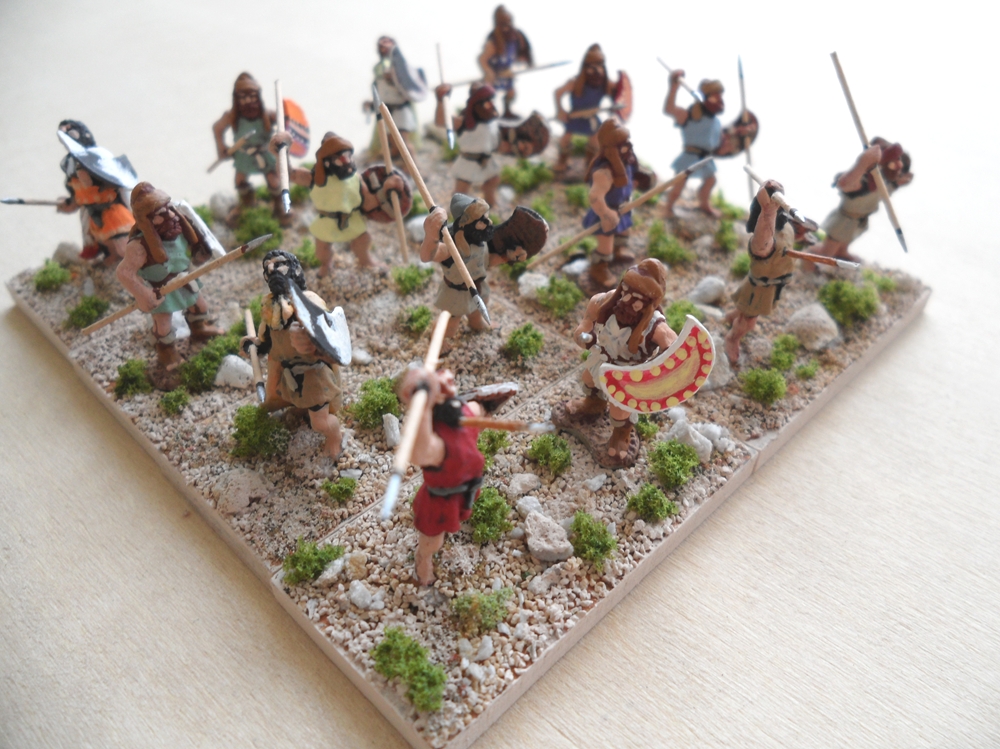
The Xyston figures I used are bits and pieces,spare packs from other projects. Painted this better equipped Late Thracian Army to fight against the Romans :o)
DBA 2.2
Army Composition: (15 elements) Miniatures by Xyston
1 x 3Cv (Gen) 3 x 2Lh or 3Ax, 6 x 3Ax, 2 x 2Ps
Historical Enemies: Phrygian, Skythians, IIIyrians, Lydian, Greeks, Early/Later Macedonians, Persians, Paionian, Galatians, Polybian,Marian and Early Imperial Romans,
Historical Notes: The history of Thracian warfare spans from 8-9th century BC up to the 1st century AD
Thracians were regarded as warlike, ferocious, dirty and bloodthirsty. They were seen as "barbarians" by the ancient Greeks and Romans. According to ancient Roman sources, the Dii were responsible for the worst atrocities of the Peloponnesian War killing every living thing, including children and the dogs in Tanagra and Mycalessos. The Thracians would impale Roman heads on their spears and rhomphaias i.e. during the Kallinikos skirmish at 171 BC. Herodotus writes that "they sell their children and let their maidens commerce with whatever men they please"
The Southern part of Thrace was conquered by Philip II of Macedon in the 4th century BC and was ruled by the kingdom of Macedon for a century and a half. Lysimachus of the Diadochi and other Hellenistic rulers ruled part or parts of Thrace until its fall to the Romans.
In 279 BC, Celtic Gauls advanced into Macedonia, Southern Greece and Thrace. They were soon forced out of Macedonia and Southern Greece, but they remained in Thrace until the end of the 3rd century BC. From Thrace, three Celtic tribes advanced into Anatolia and formed a new kingdom called Galatia.
In parts of Moesia (northeast Serbia) the Celtic Scordisci and Thracians lived beside each other, evident in the archaeological findings of pits and treasures, spanning from the 3rd century BC to 1st century BC. During the Macedonian Wars, conflict between Rome and Thracia was inevitable. The ruling parties in Macedonia weakened and Thracian tribal authority resurged. But after the Battle of Pydna in 168 BC, Roman authority over Macedonia seemed inevitable, and the governing of Thracia passed to Rome.
Initially, Thracians and Macedonians revolted against Roman rule. For example, the revolt of Andriscus in 149 BC, drew the bulk of its support from Thracia. Several incursions by local tribes into Macedonia continued for many years, though a few tribes willingly allied with Rome, such as the Deneletae and the Bessi. After the Third Macedonian War, Thracia acknowledged Roman authority.
Thrace became a Roman client kingdom around 25 BC, and a Roman province in 46 AD, Thracian troops were named or know as Equites and Auxilia in the Roman Army.
The Xyston figures I used are bits and pieces,spare packs from other projects. Painted this better equipped Late Thracian Army to fight against the Romans :o)
| Army Arrayed |
Friday, June 24, 2011
Xyston Thracian Infantry
Thracians were regarded by other people as warlike, ferocious, and bloodthirsty. They were seen as "barbarians" by the ancient Greeks and Romans. According to ancient Roman sources, the Dii were responsible for the worst atrocities of the Peloponnesian War killing every living thing, including children and the dogs in Tanagra and Mycalessos. The Thracians would impale Roman heads on their spears and rhomphaias i.e. during the Kallinikos skirmish at 171 BC. Herodotus writes that "they sell their children and let their maidens commerce with whatever men they please"
Initially, Thracians and Macedonians revolted against Roman rule. For example, the revolt of Andriscus in 149 BC, drew the bulk of its support from Thracia. Several incursions by local tribes into Macedonia continued for many years, though a few tribes willingly allied with Rome, such as the Deneletae and the Bessi. After the Third Macedonian War, Thracia acknowledged Roman authority.
Xyston Thracian Heavy Infantry
Thracians were regarded by other people as warlike, ferocious, and bloodthirsty. They were seen as "barbarians" by the ancient Greeks and Romans. According to ancient Roman sources, the Dii were responsible for the worst atrocities of the Peloponnesian War killing every living thing, including children and the dogs in Tanagra and Mycalessos. The Thracians would impale Roman heads on their spears and rhomphaias i.e. during the Kallinikos skirmish at 171 BC. Herodotus writes that "they sell their children and let their maidens commerce with whatever men they please"
The Southern part of Thrace was conquered by Philip II of Macedon in the 4th century BC and was ruled by the kingdom of Macedon for a century and a half. Lysimachus of the Diadochi and other Hellenistic rulers ruled part or parts of Thrace until its fall to the Romans.
In 279 BC, Celtic Gauls advanced into Macedonia, Southern Greece and Thrace. They were soon forced out of Macedonia and Southern Greece, but they remained in Thrace until the end of the 3rd century BC. From Thrace, three Celtic tribes advanced into Anatolia and formed a new kingdom called Galatia.
In parts of Moesia (northeast Serbia) the Celtic Scordisci and Thracians lived beside each other, evident in the archaeological findings of pits and treasures, spanning from the 3rd century BC to 1st century BC. During the Macedonian Wars, conflict between Rome and Thracia was inevitable. The ruling parties in Macedonia weakened and Thracian tribal authority resurged. But after the Battle of Pydna in 168 BC, Roman authority over Macedonia seemed inevitable, and the governing of Thracia passed to Rome.
Initially, Thracians and Macedonians revolted against Roman rule. For example, the revolt of Andriscus in 149 BC, drew the bulk of its support from Thracia. Several incursions by local tribes into Macedonia continued for many years, though a few tribes willingly allied with Rome, such as the Deneletae and the Bessi. After the Third Macedonian War, Thracia acknowledged Roman authority.
Triballi Peltasts
Xyston Thracian Light Infantry
Thracians were regarded by other people as warlike, ferocious, and bloodthirsty. They were seen as "barbarians" by the ancient Greeks and Romans. According to ancient Roman sources, the Dii were responsible for the worst atrocities of the Peloponnesian War killing every living thing, including children and the dogs in Tanagra and Mycalessos. The Thracians would impale Roman heads on their spears and rhomphaias i.e. during the Kallinikos skirmish at 171 BC. Herodotus writes that "they sell their children and let their maidens commerce with whatever men they please"
The Southern part of Thrace was conquered by Philip II of Macedon in the 4th century BC and was ruled by the kingdom of Macedon for a century and a half. Lysimachus of the Diadochi and other Hellenistic rulers ruled part or parts of Thrace until its fall to the Romans.
In 279 BC, Celtic Gauls advanced into Macedonia, Southern Greece and Thrace. They were soon forced out of Macedonia and Southern Greece, but they remained in Thrace until the end of the 3rd century BC. From Thrace, three Celtic tribes advanced into Anatolia and formed a new kingdom called Galatia.
In parts of Moesia (northeast Serbia) the Celtic Scordisci and Thracians lived beside each other, evident in the archaeological findings of pits and treasures, spanning from the 3rd century BC to 1st century BC. During the Macedonian Wars, conflict between Rome and Thracia was inevitable. The ruling parties in Macedonia weakened and Thracian tribal authority resurged. But after the Battle of Pydna in 168 BC, Roman authority over Macedonia seemed inevitable, and the governing of Thracia passed to Rome.
Initially, Thracians and Macedonians revolted against Roman rule. For example, the revolt of Andriscus in 149 BC, drew the bulk of its support from Thracia. Several incursions by local tribes into Macedonia continued for many years, though a few tribes willingly allied with Rome, such as the Deneletae and the Bessi. After the Third Macedonian War, Thracia acknowledged Roman authority.
Thracian Odrysian Archers
The Southern part of Thrace was conquered by Philip II of Macedon in the 4th century BC and was ruled by the kingdom of Macedon for a century and a half. Lysimachus of the Diadochi and other Hellenistic rulers ruled part or parts of Thrace until its fall to the Romans.
In 279 BC, Celtic Gauls advanced into Macedonia, Southern Greece and Thrace. They were soon forced out of Macedonia and Southern Greece, but they remained in Thrace until the end of the 3rd century BC. From Thrace, three Celtic tribes advanced into Anatolia and formed a new kingdom called Galatia.
In parts of Moesia (northeast Serbia) the Celtic Scordisci and Thracians lived beside each other, evident in the archaeological findings of pits and treasures, spanning from the 3rd century BC to 1st century BC. During the Macedonian Wars, conflict between Rome and Thracia was inevitable. The ruling parties in Macedonia weakened and Thracian tribal authority resurged. But after the Battle of Pydna in 168 BC, Roman authority over Macedonia seemed inevitable, and the governing of Thracia passed to Rome.
Initially, Thracians and Macedonians revolted against Roman rule. For example, the revolt of Andriscus in 149 BC, drew the bulk of its support from Thracia. Several incursions by local tribes into Macedonia continued for many years, though a few tribes willingly allied with Rome, such as the Deneletae and the Bessi. After the Third Macedonian War, Thracia acknowledged Roman authority.
Thracian Javelin men - Skirmishers
Thracian Odrysian Archers
Thracian Slingers
Xyston Thracian Cavalry
25th post...
Thracians were regarded by other people as warlike, ferocious, and bloodthirsty. They were seen as "barbarians" by the ancient Greeks and Romans. According to ancient Roman sources, the Dii were responsible for the worst atrocities of the Peloponnesian War killing every living thing, including children and the dogs in Tanagra and Mycalessos. The Thracians would impale Roman heads on their spears and rhomphaias i.e. during the Kallinikos skirmish at 171 BC. Herodotus writes that "they sell their children and let their maidens commerce with whatever men they please"
The Southern part of Thrace was conquered by Philip II of Macedon in the 4th century BC and was ruled by the kingdom of Macedon for a century and a half. Lysimachus of the Diadochi and other Hellenistic rulers ruled part or parts of Thrace until its fall to the Romans.
In 279 BC, Celtic Gauls advanced into Macedonia, Southern Greece and Thrace. They were soon forced out of Macedonia and Southern Greece, but they remained in Thrace until the end of the 3rd century BC. From Thrace, three Celtic tribes advanced into Anatolia and formed a new kingdom called Galatia.
In parts of Moesia (northeast Serbia) the Celtic Scordisci and Thracians lived beside each other, evident in the archaeological findings of pits and treasures, spanning from the 3rd century BC to 1st century BC. During the Macedonian Wars, conflict between Rome and Thracia was inevitable. The ruling parties in Macedonia weakened and Thracian tribal authority resurged. But after the Battle of Pydna in 168 BC, Roman authority over Macedonia seemed inevitable, and the governing of Thracia passed to Rome.
Initially, Thracians and Macedonians revolted against Roman rule. For example, the revolt of Andriscus in 149 BC, drew the bulk of its support from Thracia. Several incursions by local tribes into Macedonia continued for many years, though a few tribes willingly allied with Rome, such as the Deneletae and the Bessi. After the Third Macedonian War, Thracia acknowledged Roman authority.
Thracians were regarded by other people as warlike, ferocious, and bloodthirsty. They were seen as "barbarians" by the ancient Greeks and Romans. According to ancient Roman sources, the Dii were responsible for the worst atrocities of the Peloponnesian War killing every living thing, including children and the dogs in Tanagra and Mycalessos. The Thracians would impale Roman heads on their spears and rhomphaias i.e. during the Kallinikos skirmish at 171 BC. Herodotus writes that "they sell their children and let their maidens commerce with whatever men they please"
The Southern part of Thrace was conquered by Philip II of Macedon in the 4th century BC and was ruled by the kingdom of Macedon for a century and a half. Lysimachus of the Diadochi and other Hellenistic rulers ruled part or parts of Thrace until its fall to the Romans.
In 279 BC, Celtic Gauls advanced into Macedonia, Southern Greece and Thrace. They were soon forced out of Macedonia and Southern Greece, but they remained in Thrace until the end of the 3rd century BC. From Thrace, three Celtic tribes advanced into Anatolia and formed a new kingdom called Galatia.
In parts of Moesia (northeast Serbia) the Celtic Scordisci and Thracians lived beside each other, evident in the archaeological findings of pits and treasures, spanning from the 3rd century BC to 1st century BC. During the Macedonian Wars, conflict between Rome and Thracia was inevitable. The ruling parties in Macedonia weakened and Thracian tribal authority resurged. But after the Battle of Pydna in 168 BC, Roman authority over Macedonia seemed inevitable, and the governing of Thracia passed to Rome.
Initially, Thracians and Macedonians revolted against Roman rule. For example, the revolt of Andriscus in 149 BC, drew the bulk of its support from Thracia. Several incursions by local tribes into Macedonia continued for many years, though a few tribes willingly allied with Rome, such as the Deneletae and the Bessi. After the Third Macedonian War, Thracia acknowledged Roman authority.
| Thracian Light Horse |
| Thracian Northern and Southern Nobles |
Saturday, June 11, 2011
DBM Thracians
15mm Xyston Miniatures
Love my DBM Thracians and easy to paint Xyston figures! :o)
32 x Ax(Peltasts), 8 x Ps(slingers) 8 x Ps (Archers) 8 x Ps(Javelinmen) 4 x Cv(Nobles) 6 x Lh(Javelins) 6 x Lh(Getae Horse Archers)
Subscribe to:
Comments (Atom)